

Thriving among the generations
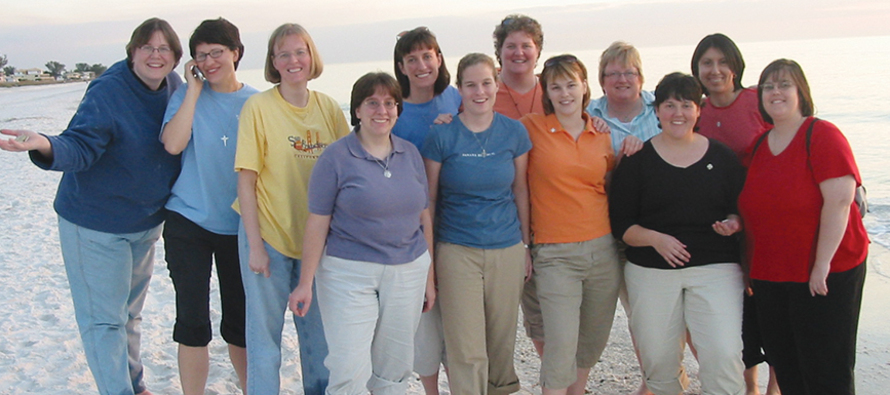
Image: SISTERS IN THEIR 20s and 30s enjoy the beach at Ellenton, Florida during a national gathering for young sisters sponsored by the Giving Voice organization.
"THEY LIKE EACH OTHER” is how Sister Maria Cimperman, O.S.U., 44, sees the two extremes of the age continuum in her religious communities, where she and many other younger members of communities in the U.S. find themselves outnumbered by their elders (though a few U.S. communities are predominantly young).
Cimperman belongs to the Ursuline Sisters in Cleveland, Ohio and teaches at the Oblate School of Theology in San Antonio, Texas. Most young religious articulate love for their elders and a desire to learn from their wisdom. Many older religious have great affection for the newbies.
Cimperman gives this example from an Ursuline region she’s familiar with: “A candidate, in her 20s, spent time over Christmas break with sisters in the infirmary and created an online video which held greetings from many of the infirmary sisters and which then was sent all over the province, reaching the U.S., Africa, Rome, and other locations where the sisters minister. This video generated energy and responses from all over the world!”
Like religious life itself, the emerging generation gap within religious communities takes many forms: It isn’t always seen as a negative, and it’s sometimes unconventional. Young and hopeful members continue to join communities out of a genuine sense of call.
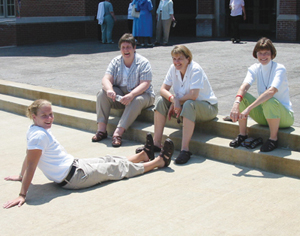
| SISTER ERIN Zubel, O.S.U. (foreground) and other young sisters relax together during a national gathering of Giving Voice, a network of sisters under age 50. |
Here is a quick picture of the generational realities in religious life today:
• Because an extraordinarily large number of people entered religious communities in the 1950s and 60s, that large and now aged population has pushed the median age of members to above 70.
• At the same time, vocation ministers report heightened interest in religious life. According to an online survey conducted by VISION, nearly 70 percent of Catholic religious communities saw a jump in vocation inquiries in 2008. Discerners—those interested in religious life—were primarily under 40 years old, and nearly 20 percent planned to enter religious formation in the next 12 months.
• A common pattern in communities is a large number of people age 70 and over, a sprinkling in their 50s and 60s, a few in their 40s, and (here’s where things vary substantially) anywhere from zero to dozens in their 20s and 30s, all in various stages of vows and formation. The new entrants frequently form a mini-United Nations, representing every country in which the congregation is present, particularly countries with booming vocations, such as Vietnam and Nigeria.
• Communities are “merging like crazy,” said Sister Mary Charlotte Chandler, R.S.C.J., who served as director of the Center for the Study of Religious Life in Chicago until its closure in 2009. More than 150 have merged since 1999. To bolster their numbers, combine resources, and preserve their commitment to their work, separate geographical entities of the same congregations are combining. And sometimes similar communities are combining.
Communities come and go
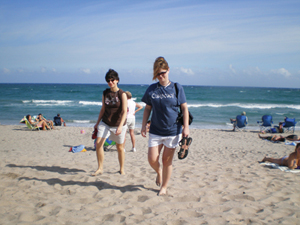
| SISTER LESLIE Keener, C.D.P. and Sister Katy LaFond, O.S.F. stroll the beach during a gathering of sisters in their 20s and 30s. |
Since the dawn of religious life some 2,000 years ago, there have been several cycles of expansion and decline—with communities forming to meet a pressing need within church and society and then dying out because of changing needs, internal laxity, or both. Chandler takes the long view, which is shared by many: “The form of religious life will shift, and we’re probably in the middle of a shift now.” She foresees an emphasis on contemplation combined with service, on public witness, and on communal living and mission.
Younger religious also have a sense of their moment in religious life’s history. “We entered knowing that there are small numbers now. I have empathy for the older men who have been through a lot,” said Brian Zumbrum, O.S.F.S., 23, referring to the changes that took place in the 1960s and 70s following the Second Vatican Council.
“I have a realistic view that in 40 or 50 years our community fading out of existence is a possibility,” said Zumbrum, who is a novice in Washington, D.C. preparing for life with the Oblates of St. Francis de Sales. “That came up in my discernment process. I believe I’ve been called to be here. If I’m the last one called here, that’s OK.” Still, Zumbrum is anything but gloomy. When he discusses his life, he has the sound of a man giddy in love—and he’s fallen hard for his community.
That strong sense of calling is a trademark of young adults in religious life today. They didn’t just wake up one day and decide the convent or seminary seemed like a good idea. Most of them struggled, were challenged by friend and foe, and kept hearing God calling them to their particular community.
Old and new approaches
These “kids” or “babies” (as many of their elders called them) know they are where they belong. They are in the right place, but the right place can carry with it some tensions. Different generations have distinct life experiences, energy levels, prayer forms, technology habits, and attitudes toward religious garb. Sometimes those differences complement one another, and other times the classic generation gap with all its frustrations can arise.
“There is a lot of wisdom that the older guys do bring with them,” said a 30-year-old seminarian who asked not to be named. “At the same time it’s important for the older ones to listen to the younger ones because maybe that’s where the church is moving.” This seminarian calls for mutual respect in the distinctions between younger men in his community who are attracted to Eucharistic adoration and the older ones who see it as sign of weak theology that limits God’s presence.
He also welcomes openness within the community and discussion in regard to the emphasis among the young on external signs, particularly religious garb. “Older people have internalized their identity,” he noted. “They have less need to be in [clerical garb].” Often Catholic symbols mean one thing to the young (for whom religious habits are a public witness, showing love for the church) and another to the old (for whom habits separate religious from laity). Young and old agree that it helps to keep talking across the generations.
| SISTER Erin Zubel, O.S.U. |

Negotiating the different energy levels of older and younger generations requires a similar attitude of respect, and it also has led young religious outside their own communities to meet their need to relate to peers. Senior members often don’t have the energy to stay up late at night the way many young adults do. “It is important for me to stay connected with some of my college friends. We try to get together for a movie or hang out at a friend’s house,” said Sister Erin Zubel, O.S.U. of the Ursuline Sisters of Cleveland, who also enjoys gardening.
She and several of the women interviewed for this article also attend Giving Voice gatherings—intercommunity gatherings of sisters under age 50 (see www.giving-voice.org)—and stay in touch with friends found there. Because the culture of religious life is more open than it used to be, and because there are so few young people, the elders in many communities encourage their younger members to connect with peers from all walks of life.
| SISTER Jennifer Marie Zimmerman, S.N.D. |

Of course there may be less of a gap to negotiate in any given community, depending on the personalities involved. Harmony in a living or ministry situation often seems to come down to attitudes, openness, and personalities. Sister Jennifer Marie Zimmerman, S.N.D., 29, of the Sisters of Notre Dame in Toledo, Ohio said, “I was aware of the age difference, sure, but never stopped to think about it when I first entered. The sisters I knew best before entering the community were in their 40s and 50s, with a very ‘young’ spirit.”
How to keep the vision alive
Cimperman puts forth a challenge to communities that are learning to live with a large population of elders at the same time that they greet newcomers: Tend to retirement and old age but be sure to keep the mission alive and keep it big. “It’s got to be epic,” she said. “The gospel is epic, so it’s got to be big.”
“Truthfully, the focus needs to be both places. The group has to look at finances and . . . it’s also great that we’re still mission-oriented and concerned with service,” said Zimmerman.
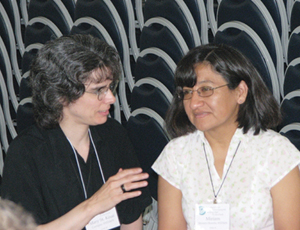
| SISTER MARY St. Kasai Corripio, S.N.D.deN. speaks with Sister Miriam Montero Bereche, S.N.D.deN., a sister from Peru, during a gathering of Giving Voice, www.giving-voice.org. |
If striking a balance is important, then communities will need to conduct a lot of conversations about their future. Not all communities are. Some religious are hesitant to talk about age issues. Other community leaders are encouraging discussion, asking: Will the community survive? Is it embracing a mission worthy of a person’s life? How will the elders be cared for? How will the community pay for their care?
These questions could haunt young religious if they allow them to. Do any of the young members ever lie in bed wondering whether their community will exist in a few decades? “If I want to make myself crazy, I do,” joked Zimmerman. But she and other young religious kept returning to the same theme when questioned about the future. God has called them. Life is a risk whether you commit to religious life or another way of life. Trust God.
“I would tell VISION readers to take the risk of trying this life,” said Zumbrum. “There’s no better time to take a leap than when you’re young.”
Tags
Related
- Questions you’ll be glad you asked
- What monastic mystics got right about life
- Religious communities embrace diverse members
- How my parents responded when I became a brother
- Vocation Basics: You are already called—Message to youth from Pope Francis
- Meet the parents
- Charism: The gift that shapes lives
- What our vows mean
- Discover five treasures of religious life
- Religious making a difference Read More
Most Viewed
- Find your spirituality type quiz
- Questions and answers about religious vocations
- Celibacy quiz: Could I be a nun? Could I be a brother? Could I be a priest?
- Resources for older discerners or those with physical and developmental differences
- About Vocation Network and VISION Guide
Most Emailed
 Carol Schuck Scheiber is content editor for VISION.