

Sisters form a colorful bouquet
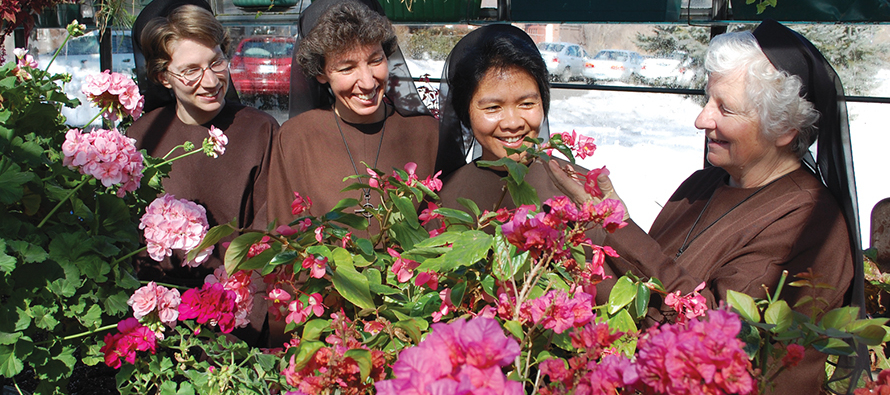
Image: Enjoying the blooms in the community greenhouse are members of the Franciscan Sisters of the Eucharist (from left): Sister Grace Marie Horan, F.S.E., Sister Frances Zajac, F.S.E., Sister Rosario Ongayo, F.S.E., and Sister Patricia Glass, F.S.E.
WE USUALLY THINK of a sister as someone who shares a common bond through family or a social group. Being a sister is a forever-relationship in family but can also be a lifelong commitment to a group with a common vision. In this light, who and what is a religious sister? Who are these women living in community and bonded by a mutuality of call? What is this life illuminated by the vows of chastity, poverty, and obedience?
Sisters come in many varieties
As a Franciscan Sister of the Eucharist I respond to these questions from the perspective of my own Franciscan “family.” The deep mystery of religious life is difficult to address briefly, and I would like to deal with it through an analogy taken from what I most love to do in my free time: working in flower gardens.
When I look at a garden, I am aware of its size, its boundaries, its colors, and the overall arrangement. One can also focus on the type of soil, the relationship to the sun, the frequency of rain or other sources of water, or on the weeds (a topic best left to another discussion).
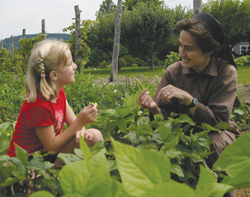
| Sister Raffaella Petrini, F.S.E. talks with a young friend about gardening. |
As I roam about in the “garden” that is my community, I wonder at the beauty of the overall relationships, the uniqueness of each of our “flowers,” and above all the diversity of types and colors. Sisters come in so many different individual varieties: Some have brilliant color and some are more delicate; some have very strong stems and some are more pliable. Some flowers are perennials (come up every year on their own) and some are annuals (are planted each year and bloom for one season). We need all kinds to fulfill the call of any individual community.
Sisters flourish when properly nurtured
The members of a community are also like a single flower that is a combination of many petals with a center. Each petal has a beauty and contributes to the total flower. In community our center is Jesus Christ in the Eucharist. As we come together for liturgy and prayer, each heart is centered by personal and intimate union with Christ, and yet the whole community as one body worships Christ at Mass, in adoration of the Blessed Sacrament, and in meditation. This centering enhances the beauty of each “flower” as well as the whole community and feeds its very existence.
Sisters also devote their energy and time to apostolic work, meeting the needs of others. In my own community they serve others through counseling families and individuals and through home care and hospice care that enters into the pain and suffering of the sick and the dying and their families. Other sisters answer the call to education in preschools and elementary and high schools or teach in colleges, universities, and seminaries. These are all different flower gardens, and each situation calls for a unique answer and, above all, preparation for the service needed.
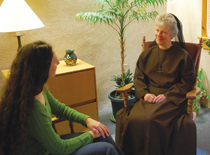
| Sister Mary Elizabeth Endee, F.S.E. speaks with a young woman at the Franciscan Life Center, Meriden, Connecticut, one of the Franciscan Sisters of the Eucharist’s counseling centers. |
Yet in this great diversity our sisters deeply appreciate the gifts of others. As one views the union of these gifts in each religious community, appreciation grows for the diversity of unique women who can lovingly be part of a greater whole. Religious women serve the multitudinous needs of people around the world in a great variety of ways. Some communities are “perennial gardens” that work persistently year after year, while many move about in “annual” gardens and diversify according to the needs of a particular area and group in crisis. Sisters fulfill the charism and mission of their own community but more important, they remember the needs of all of the people of the world through their prayer.
Individuals and families a sister serves know that they are also served and loved by an entire community. A religious sister is so much more than an individual; she is part of a whole that desires to fulfill the particular mission of her community and share their lives, energy, and talent. Although the rose or petunia or pansy may have the attention of the moment, our wider vision sees the greater reality. Often as a home-care worker leaves a home, the patient’s parting words are “tell the sisters to pray for me.” These requests come home to community prayer and liturgy and are usually written in a special book in our chapel to be remembered in future prayer.
Sisters transform and blossom
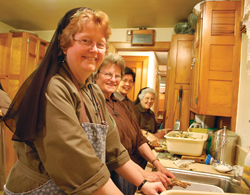
| Cleaning horseradish from their community’s vegetable garden are (from left) Sister Anna Rose Kalinowski, F.S.E, Sister Suzanne Gross, F.S.E., Sister Monica Navalta, F.S.E., and Sister Mary Richards, F.S.E. |
While being a sister involves the harmony of individual and community, often the reality of a sister has other aspects that seem to be paradoxical or contradictory to the name sister. According to the dictionary, a paradox is a statement contrary to common belief or having inconsistent qualities.
For instance, most religious women are known as “sisters” and yet they fulfill the role of mother and spouse. The gift to nurture and bring forth life is often seen in the relationship of a sister to the people she serves. Many a child, suffering person, and troubled individual have known the warmth and total sacrifice of a motherly sister who gave them what they needed at the time.
How many schools, social work organizations, nursing care facilities, and foreign missions have been brought into existence through a sister who gave her life to the paradox of sacrificing her own desire to have children to be the mother of the many? This sacrifice moves beyond the one-to-one to the one-to-the-many.
Likewise sisters know the fulfillment of the call to be spousal through their commitment to fidelity and faithfulness to community, the church, and Christ. This gift of fidelity meets a great need in being a countercultural influence in a world that struggles with infidelity.
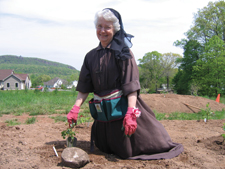
| Mother Shaun Vergauwen, F.S.E. in the community’s new rose garden in Meriden, Connecticut. |
Another paradox in the life of a sister: A sister gives her individual fulfillment over to the discretion of the community and as a result has an opportunity for a deep personal fulfillment and development of her human wholeness. Likewise each sister is called both to her own individual vocation to holiness as well as to a community of persons striving together to attain this unique call to holiness. In other words, a sister gives all and in that freedom also receives an abundance of gifts in return. Each Christian is called to a life of holiness individually, and yet to live in a community striving for holiness is a great blessing. Not only prayer and apostolic work are abundant in the life of a sister but also the community life of sharing meals and relaxation overflows with grace and goodness.
Religious women live these paradoxes as well as a daily life founded on vows of chastity, poverty, and obedience. In the “garden” perhaps we can say that chastity defines the boundaries of life, poverty helps one to use only what is needed for the growth of the individual flower, and obedience helps each sister to be in relationship to her own freedom, to the charism of her community, and to the life of the universal church.
Tags
Related
- A vocation found on the low road: Profile of Sister Thanh Pham, S.S.M.O.
- Missioned to make connections
- Need-to-knows about becoming a nun
- An art teacher is drawn to something greater: Profile of Sister Lisa Perkowski, I.H.M.
- What a flock of sheep taught its shepherdess
- Sister Vilma’s fearless faith
- Seeing God in a child’s smile: Profile of Sister Marie Elizabeth Jerry, S.S.F.
- Bringing sacred healing to hurting communities
- Sisters help Uvalde move from trauma to trust
- Camaraderie at its best: Profile of Sister Kristine Fernandes, C.S.J. Read More
Most Viewed
- Find your spirituality type quiz
- Questions and answers about religious vocations
- Celibacy quiz: Could I be a nun? Could I be a brother? Could I be a priest?
- Resources for older discerners or those with physical and developmental differences
- About Vocation Network and VISION Guide
Most Emailed
 Mother Shaun Vergauwen, F.S.E. is the superior general of the Franciscan Sisters of the Eucharist, whose motherhouse is in Meriden, Connecticut.