


In the early church the answer was simple: Confirmation was part of the initiating rites of Christianity along with Baptism and Eucharist. All three were administered together on the same occasion as one embraced the faith. With the rise of infant baptism, however, the anointing that confirmed faith was separated from the water rite that signaled reception into the church. The reluctance to give Eucharist to infants led to the disintegration of a unified initiating rite.
The term “sacraments of initiation” was introduced at the end of the 19th century, mostly by liturgists and theologians. The term made it into the Code of Canon Law in 1983 when these three sacramental moments were declared “so interrelated that they are required for full Christian initiation” (Canon 842.2). To understand Confirmation, then, is to appreciate how it stands together with these sacraments as much as how it stands apart—if in fact it can be said to do so at all.
From its earliest practice, the imposition of hands and the anointing with oil signified the imparting of the Holy Spirit to the newly baptized. Around 416 Pope Innocent I allowed a priest to use chrism (blessed oil) at Baptism but insisted that signing the brow with the oil be reserved to the bishop. That created problems because bishops were not omnipresent in the church then or now. Once Confirmation was delayed, the second oil anointing required justification. Perhaps it was seen to provide spiritual strength for the battles of life; as this idea became popular, the bishop’s welcoming kiss was replaced with a slap to signify the entrance into spiritual conflict.
Over the centuries both parents and bishops got lazy about administering this additional sacrament—which, frankly, is not a little problem even today. To ensure its practice, church councils established age requirements, anywhere from one to seven, with the maximum permitted being seven, the age of reason. Human nature being what it is, the maximum became the standard, except in danger of death.
Efforts to close the gap between the first and last initiating sacraments went on for centuries, but a clause in the Confirmation rite itself, which gave bishops’ conferences the right to “set an age that seems more suitable” after proper formation “when the recipients are more mature,” invited the practice of adolescent Confirmation into the mix. Confirmation is now popularly understood as a rite of passage into Christian adulthood, and remains, as many theologians call it, “a practice in search of a theory.”
Scripture
• 2 Corinthians 1:21-22; Ephesians 1:13-14
Online
• Podcast: The Sacrament of Confirmation - Wendy M. Wright interviews John O’Keefe about the Sacrament of Confirmation in historical context, from the Center for Catholic Thought, Creigton University
Books
• The Confirmed Catholic’s Companion: A Guide to Abundant Living by Sister Mary Kathleen Glavich, S.N.D. (ACTA Publications, 2013)
• I Have Chosen You - Candidates's Journal and I Have Chosen You - Leader’s Guide byJoseph Moore (Paulist Press, 2004)
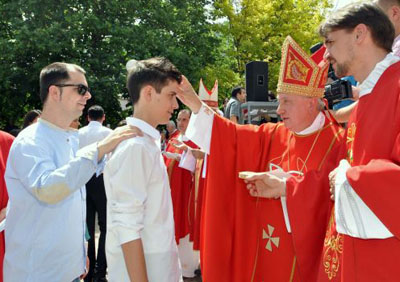 |
| CELEBRATION of Confirmation in Mostar, Bosnia and Herzegovina. ©Zvonimir Ćorić, Catholic News Agency, Bishops' Conf. of Bosnia and Herzegovina |
From its earliest practice, the imposition of hands and the anointing with oil signified the imparting of the Holy Spirit to the newly baptized. Around 416 Pope Innocent I allowed a priest to use chrism (blessed oil) at Baptism but insisted that signing the brow with the oil be reserved to the bishop. That created problems because bishops were not omnipresent in the church then or now. Once Confirmation was delayed, the second oil anointing required justification. Perhaps it was seen to provide spiritual strength for the battles of life; as this idea became popular, the bishop’s welcoming kiss was replaced with a slap to signify the entrance into spiritual conflict.
Over the centuries both parents and bishops got lazy about administering this additional sacrament—which, frankly, is not a little problem even today. To ensure its practice, church councils established age requirements, anywhere from one to seven, with the maximum permitted being seven, the age of reason. Human nature being what it is, the maximum became the standard, except in danger of death.
Efforts to close the gap between the first and last initiating sacraments went on for centuries, but a clause in the Confirmation rite itself, which gave bishops’ conferences the right to “set an age that seems more suitable” after proper formation “when the recipients are more mature,” invited the practice of adolescent Confirmation into the mix. Confirmation is now popularly understood as a rite of passage into Christian adulthood, and remains, as many theologians call it, “a practice in search of a theory.”
Scripture
• 2 Corinthians 1:21-22; Ephesians 1:13-14
Online
• Podcast: The Sacrament of Confirmation - Wendy M. Wright interviews John O’Keefe about the Sacrament of Confirmation in historical context, from the Center for Catholic Thought, Creigton University
Books
• The Confirmed Catholic’s Companion: A Guide to Abundant Living by Sister Mary Kathleen Glavich, S.N.D. (ACTA Publications, 2013)
• I Have Chosen You - Candidates's Journal and I Have Chosen You - Leader’s Guide byJoseph Moore (Paulist Press, 2004)