

Although there have been 21 “ecumenical councils” convened so far in the church’s history, Trent (the 19th) has the rest beat in many ways. For one thing, it lasted the longest, from 1545-1563. It crossed the reigns of five popes, including Paul III, Julius III, Marcellus II, Paul IV, and Pius IV, and two emperors (Charles V and Ferdinand). This council comprised 25 sessions and issued more reforms and dogmatic decrees than any prior, setting the church on its course for the next 400 years.
An ecumenical council usually involves assembling bishops and others who represent the entire church from all over the world, so it’s not undertaken lightly or frequently. While two such councils have followed in the wake of Trent, Vatican I (1869-1870) lasted less than a year and was never formally finished due to the outbreak of war. The more well-known Vatican II (1962-1965) is the only council since Trent to have a significant impact on the direction of the church.
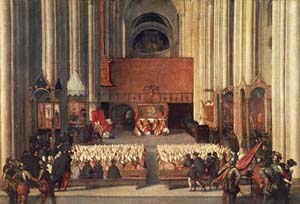 |
| A SESSION of the Council of Trent. |
Why did Trent pack such a punch? Timing: It was a response to the challenges issued by the Reformation and gave birth to the movement known as the Counter-Reformation. It reexamined the nature of faith, grace, sacraments, the power of the papacy, and education of the clergy.
But the council was also good for drama: a great historical mess of a convocation, adjourned several times due to turmoil from within and without. Paul III convened it, hoping to respond to Luther’s reforms in a matter of months. He made the greatest progress of the entire 18 years in the first two years by affirming the “equal reverence” of scripture and tradition—contrary to Luther’s insistence on scripture alone—and producing the response to Lutheran teaching on “justification by faith.” Paul III also oversaw teachings on the efficacious nature of sacraments and the affirmation of seven of them—contrasted with the Lutheran adherence to two. The rest of the agenda was left to his successors.
Julius III made his contribution in affirming other teachings on the sacraments, especially the Real Presence of Christ in the Eucharist, opposing the purely symbolic approach of the reformers Zwingli and Calvin. Marcellus II showed great promise but died 20 days after assuming the office. Paul IV had no interest in continuing the council at all, holding what have since been called “unrealistic” views of papal authority; it was he who first issued the Index of Forbidden Books—so extensive it shocked even his supporters. Pius IV reconvened Trent in the face of new threats from Calvinism. He defined the nature of ordination’s indelible character and the sacramentality of marriage and brought the council successfully to a close. In the face of a sea change in the Christian world, the Catholic self-understanding had been expressed in ways that would prove enduring.
Scripture
• Predecessor to the councils: Acts 15, the “Council of Jerusalem”
Online
• Texts of the documents of the Council of Trent
Books
• The General Councils: A History of the Twenty-One Church Councils from Nicaea to Vatican II by Christopher M. Bellitto (Paulist Press, 2002)
• The Ecumenical Councils of the Catholic Church: A History by Joseph F. Kelley (Liturgical Press, 2009)